Showing posts with label Hong Kong. Show all posts

08 May, 2020

Temple of Heaven: an Imperial Sacrificial Altar in Beijing

country. China
year of inscription. 1998
criteria. Cultural
The Temple of Heaven WHS is located in the municipality of Beijing. Founded in the first half of the 15th century CE, it is a complex of buildings set in gardens, dominated by old pine woods. Set in a north-south axial format, the layout and assemblage seek to symbolise the relationship between heaven and earth as well as that between the divine and humans, as defined by Chinese cosmology. Central to the mediating of these relationships was the Chinese emperor. It was here that emperors of the Ming (1368CE – 1644CE) and Qing (1644CE – 1911CE) Dynasties would come to perform ceremonies that offer sacrifices and prayers for bountiful harvests. Due south of the Forbidden City – the imperial residence – the site was first used for this purpose in 1420CE, given its current name after some repurposing and reconstruction in 1534CE, and rebuilt to its current form in 1749CE.

22 December, 2019

Cultural Landscape of Honghe Hani Rice Terraces

where. China
what. stamps (Hong Kong, 2015)


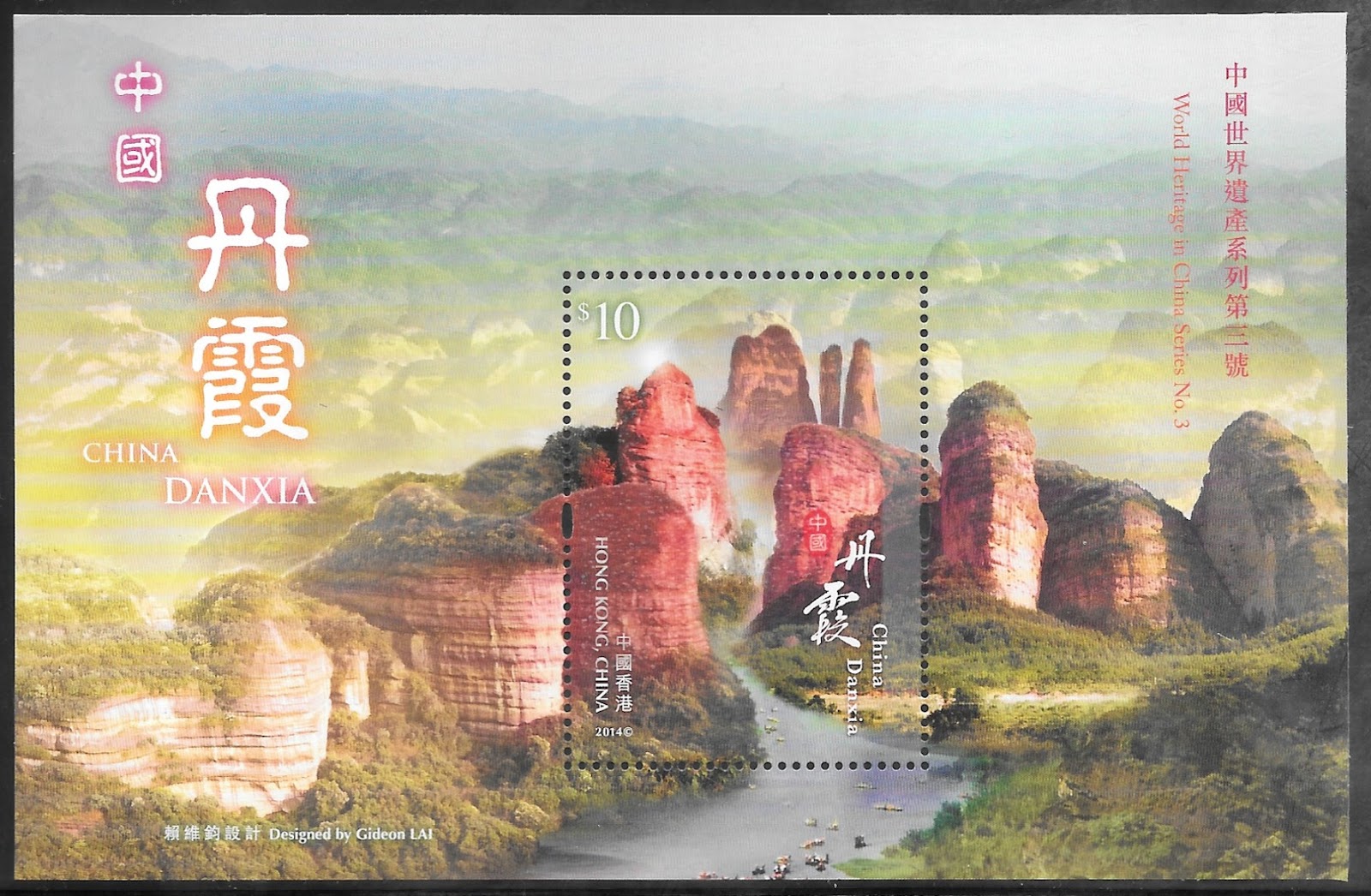
China Danxia

where. China
what. stamps (Hong Kong, 2014)


The Great Wall

country. China
year of inscription. 1987
criteria. Cultural
The origins of the Great Wall can be traced to 220BCE, when, under Qin Shi Huang, sections of earlier fortifications were linked to provide a unified defense system against invasions from the north. Construction continued from the 3rd century BCE to 17th century CE, in the Ming Dynasty. With a total length of some 20,000km, it runs from Jiayuguan in Gansu province eastwards to Shanhaiguan in Hebei province, across seven provinces of Gansu, Ningxia, Shaanxi, Shanxi, Hebei, and Liaoning, as well as the two municipalities of Beijing and Tianjin.

Huanglong Scenic and Historic Interest Area

where. China
what. stamp (Hong Kong, 2011)


South China Karst

where. China
what. stamp (Hong Kong, 2011)


Mount Taishan

where. China
what. stamp (Hong Kong, 2011)


21 December, 2019

Xinjiang Tianshan

country. China
year of inscription. 2013
criteria. Natural
The Xinjiang Tianshan WHS comprises of four component sites – Tomur Kalajun-Kuerdening, Bayinbukuke, and Bogda – in the autonomous region of Xinjiang, which are part of the Tianshan mountain system. These areas have unique physical geographic features and scenically beautiful areas of contrasting environments and landscapes. They are also home to endemic and relic flora species, including some rare and endangered ones.

Huanglong Scenic and Historic Interest Area

where. China
what. stamp (Hong Kong, 2008)

South China Karst

where. China
what. stamp (Hong Kong, 2007)

Mount Taishan

where. China
what. stamp (Hong Kong, 2006)

19 December, 2019

Old Town of Lijiang

country. China
year of inscription. 1997 (modification: 2012)
criteria. Cultural
The Old Town of Lijiang WHS is located in the province of Yunnan and is comprised of Dayan Old Town and two village housing clusters to the north: Baisha and Shuhe. Dayan is a historic town founded in the Ming Dynasty (1368CE – 1644CE). The architecture here is reflective of the Naxi people, incorporating elements of Han and Tibetan design motifs. The town also boasts of a complex and ingenuous water-management system, which draws on water and springs on Yulongxueshan (Jade Dragon Snow Mountain) to feed the Heilongtan (Black Dragon Pond) from which water is distributed via a system of canals and channels. Baisha was established earlier during the Song (960CE – 1279CE) and Yuan (1271CE – 1368CE) Dynasties, and is renowned for its religious complex, which contains paintings dating back to the 13th century CE, relating to Buddhism, Taoism, and the Naxi people, with influence with cultural elements of the Bai. Shuhe’s layout reflect a blend of local customs, cultures and traditions.

18 November, 2019

Classical Gardens of Suzhou

country. China
year of inscription. 2000
criteria. Cultural
The Classical Gardens of Suzhou WHS is a collection of historic gardens found in the city of Suzhou in Jiangsu province. Constructed between the 11th and 19th centuries CE, they epitomise the aesthetic features of the genre. These gardens combine metaphysical philosophies, elements of human design, and concepts of natural beauty, within a single compound in an urban setting. Incorporating elements like water, stones, plants, and various types of buildings of literary and poetic significance containing furniture and artworks, these gardens are seen as embodiment of Chinese culture and artistic attainment.

The nine gardens included in the WHS are the:
  • Canglang Pavilion (沧浪亭),
  • Couple’s Garden Retreat (耦园),
  • Garden of Cultivation (艺圃),
  • Humble Administrator’s Garden (拙政园),
  • Lingering Garden (留园),
  • Lion Grove Garden (狮子林园),
  • Mountain Villa with Embracing Beauty (环秀山庄),
  • Net Master’s Garden (网师园), and
  • Retreat & Reflection Garden (退思园).

The Grand Canal

country. China
year of inscription. 2014 (modification: 2016)
criteria. Cultural
The Grand Canal is a waterway system which was a crucial transport and communication lifeline in imperial China, linking Beijing to Hangzhou. With some sections first constructed in the 6th century BCE, it was unified as a system during the Sui Dynasty in the 7th century CE and reached its peak in the 13th century CE Yuan Dynasty, when some 2,000km of artificial waterways had been constructed to link five of the main water basins of China. This was an extensive engineering project that was unparalleled in the world before the Industrial Revolution. Still in use today, the thirty-one component sites of the WHS is located in the municipalities of Beijing and Tianjin and the provinces of Hebei, Henan, Shandong, Anhui, Jiangsu, and Zhejiang.

22 September, 2019

Kaiping Diaolou and Villages

country. China
year of inscription. 2007
criteria. Cultural
Kaiping, in the province of Guangdong, is the home of villages which feature diaolou. Dialou is a multi-storeyed defensive village houses that reflect a complex, flamboyant fusion of Chinese and Western architectural forms. While they were built as early as during the Ming Dynasty (1368CE - 1644CE), they reached a peak during the Warlord Era (1916 - 28CE), in response to warfare and banditry. They were often built with financial aid from Chinese emigrants to Southeast Asia, Australasia, and North America in the late 19th and early 20th century CE. They could take the form of: one, communal towers for use as refuge for a few families; two, fortified residential towers of rich households; and, lastly, watch towers. 

15 April, 2019

Fujian Tulou

country. China
year of inscription. 2008
criteria. Cultural
The Fujian Tulou WHS is a collection of forty-six buildings found in the southwest of Fujian province. Built between the 15th and 20th centuries CE, and set amongst agricultural fields, tulou are multi-storey earthen houses that are either squarish or circular, and constructed to look inwards. Designed for defense purposes, they typically only have one entryway to the outside, housing the whole clan of up to 800 people within. Inside, the building is divided into individual rooms for family units. The tulou exemplifies a traditional building whose functionality centred on communal living and defensive organisation, with respect to feng shui (Chinese geomancy) principles.

Grand Canyon National Park

PAGE UNDER CONSTRUCTION country.  Japan year of inscription.  2018 criteria.  Cultural